
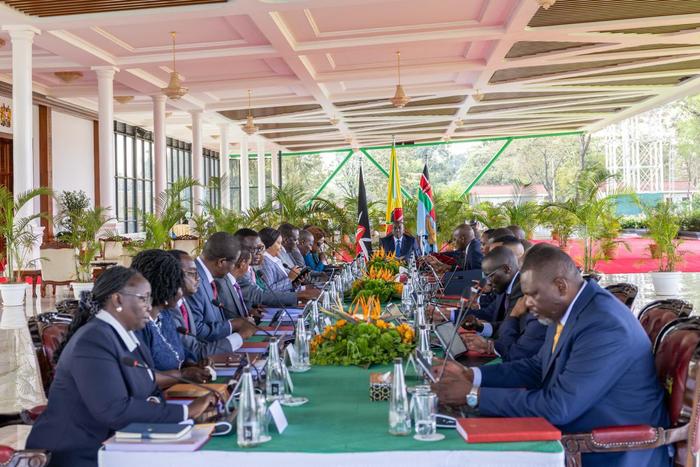
A Cabinet Secretary Performance Rating by Microtrak Africa has highlighted a group of Cabinet Secretaries whose ministries are associated with major infrastructure, tourism, housing, security, sports, mining, public service, finance and energy initiatives.
The assessment places the Cabinet Secretaries in the following order, beginning with Davis Chirchir and ending with James Opiyo Wandayi. The order below reflects the Microtrak Africa rating shown in the supplied material and is not an independent ranking by this publication.
1. Davis Chirchir — Roads and Transport
Davis Chirchir tops the Microtrak Africa performance rating, with his Roads and Transport docket associated with several major infrastructure programmes.
A key project highlighted is the Rironi–Mau Summit highway, where the government has embarked on a major dualling programme along the Northern Corridor covering the Rironi, Naivasha, Nakuru and Mau Summit route. The project is intended to ease congestion, shorten travelling time and improve road safety.
The ministry has also overseen plans for the modernisation and expansion of Jomo Kenyatta International Airport, with the objective of increasing capacity and strengthening Kenya’s position as a regional aviation hub.
Another major undertaking is the continued expansion of the Standard Gauge Railway towards Western Kenya, with the planned extension from Naivasha towards Kisumu and Malaba expected to improve movement of people and goods while strengthening regional trade.
The rating also points to progress in road construction and rehabilitation, with about 2,700 kilometres of roads reportedly upgraded to bitumen standards over the past three years.
Chirchir’s docket has additionally been involved in efforts to clear contractors’ pending bills. In August 2026, the government announced the mobilisation of about KSh139 billion to settle certified outstanding payments and help accelerate stalled projects.
The ministry is also increasingly turning to public-private partnerships to finance large infrastructure projects, reducing reliance on conventional government-budget financing.
2. Rebecca Miano — Tourism and Wildlife
Rebecca Miano’s Tourism and Wildlife docket is highlighted for strong tourism growth and efforts to broaden the country’s tourism offering.
According to the rating, Kenya recorded 2.7 million international visitors and 5.2 million domestic visitors in 2025, while tourism earnings reached approximately KSh500 billion. International arrivals were also reported to have grown by 9 percent.
The assessment notes that Kenya’s tourism strategy is increasingly moving beyond traditional safari and beach tourism. Cultural heritage, sports tourism, cruise tourism, destination weddings and MICE — meetings, incentives, conferences and exhibitions — are increasingly being incorporated into the country’s tourism proposition.
Miano’s ministry has also pursued digital transformation, including collaboration with Google Kenya on an AI-driven tourism strategy. The initiatives include a Tourism Pulse Data Hub, AI-powered trip planning and digital-skills programmes aimed at young people and tourism SMEs.
The rating further highlights the ministry’s emphasis on inclusive tourism, with greater attention to communities, women, young people and small businesses so that tourism growth generates wider economic benefits.
Tourism is also being linked more closely to wildlife conservation. Recent conservation initiatives have sought to improve visitor experiences while ensuring communities benefit economically from wildlife resources. The rating notes that visitation to parks and reserves has risen to about 3.5 million, compared with roughly two million previously.
3. Eric Muriithi Muuga — Water, Sanitation and Irrigation
Water, Sanitation and Irrigation Cabinet Secretary Eric Muriithi Muuga is recognised in the rating for initiatives aimed at expanding access to water while strengthening irrigation and food security.
Among the projects highlighted is the Nyamanche Springs Water Supply Project, which is being implemented to serve approximately 3,700 households. The Ntimaru Water Supply Project is also expected to benefit about 4,700 households.
The rating further points to the ministry’s focus on moving agriculture away from excessive dependence on rainfall towards irrigated farming.
The National Irrigation Sector Investment Plan forms part of the broader government strategy to expand irrigation and strengthen food security.
4. Alice Wahome — Lands, Public Works, Housing and Urban Development
Alice Wahome’s ministry is highlighted particularly for its role in the government’s Affordable Housing Programme.
The assessment notes that affordable and social housing projects are being rolled out in different parts of the country, with projects listed in areas including Nairobi, Machakos, Embu and Kibera. The national programme is targeting more than 200,000 housing units.
Importantly, the housing programme is not limited to Nairobi. Projects and programmes are being implemented across the 47 counties, giving the housing agenda a broader national-development focus.
Wahome’s docket is also involved in upgrading informal settlements through programmes such as the Kenya Informal Settlements Improvement Programme (KISIP), which seeks to improve infrastructure and living conditions in underserved urban communities.
The ministry is simultaneously pursuing the redevelopment of existing public housing estates. The Shauri Moyo redevelopment project in Nairobi, for example, is designed to modernise an older public housing estate while providing approximately 2,400 units.
Technology has also been incorporated into housing access through the Boma Yangu platform, which allows citizens to register, save towards a home, view available units and track applications digitally.
5. Kipchumba Murkomen — Interior and National Administration
Interior and National Administration Cabinet Secretary Kipchumba Murkomen is highlighted for a series of technology and institutional reforms within the security and national-administration sector.
One area is the digitalisation of policing, including the Digital Occurrence Book and Case Management System, intended to improve police record-keeping, investigations and operational efficiency.
The rating also highlights a major forensic milestone in July 2026, when Kenya’s Directorate of Criminal Investigations received international accreditation for its Forensic Evidence Management Unit.
Another initiative is the Multi-Biometric Identification System, which has the potential to significantly shorten the processing time for Police Clearance Certificates under optimal conditions.
Murkomen has also overseen efforts to improve access to national identification services, including mobile ID-registration drives targeting young people, expansion of registration services and changes intended to make first-time ID applications more accessible.
The ministry has further worked on strengthening security and administration structures, including the launch of the National Government Administration Police Unit and its 2025–2028 service-delivery roadmap.
The rating also points to efforts to position police stations as centres of professional public service, with greater emphasis on accountability, community cooperation, intelligence gathering and operational excellence.
6. Geoffrey Ruku — Public Service, Human Capital Development and Special Programmes
Public Service and Human Capital Development Cabinet Secretary Geoffrey Ruku is recognised for his focus on improving how government services reach citizens.
His ministry has a central role in coordinating public services and improving their efficiency across the country.
The rating also highlights Ruku’s role in disaster preparedness, response and recovery, with an emphasis on creating a more coordinated and institutionalised system involving national and county governments, humanitarian organisations and communities.
The approach seeks to strengthen Kenya’s ability to respond to disasters while improving coordination between the various institutions involved.
7. Salim Mvurya — Youth Affairs, Creative Economy and Sports
Salim Mvurya’s portfolio receives recognition particularly for Kenya’s preparations for major sporting events and the development of long-term sports infrastructure.
A major project is the Talanta Sports City, which includes a 60,000-seat stadium. By August 2026, reports cited in the assessment placed the wider complex at more than 90 percent completion, with the facility being prepared as one of Kenya’s key venues for the 2027 Africa Cup of Nations.
Mvurya’s docket has also been involved in inspections and coordination of stadium works, training pitches and supporting facilities as Kenya prepares to co-host AFCON 2027 with Uganda and Tanzania.
Beyond the tournament, Talanta Sports City is designed as a broader sports complex with training facilities and supporting infrastructure.
The rating also highlights government efforts to strengthen rewards and support for athletes, while positioning sports and talent development as potential sources of livelihood for young Kenyans.
The infrastructure programme is consequently being presented as part of a wider effort to strengthen Kenya’s capacity to host international sporting events and develop sports as an economic and youth-opportunity sector.
8. Hassan Ali Joho — Mining, Blue Economy and Maritime Affairs
Hassan Ali Joho’s Mining, Blue Economy and Maritime Affairs docket is highlighted for its push towards mineral value addition.
The draft Minerals, Mining and Beneficiation Policy seeks to move Kenya away from exporting raw minerals by encouraging local processing, technology transfer and the development of downstream industries.
The policy has an ambitious target of increasing mining’s contribution to the economy from around one percent of GDP towards 10 percent by 2030.
Joho has also directed mining officials to strengthen compliance, enforcement and governance while tackling illegal mining, which the ministry identifies as a source of environmental damage, lost revenue and unsafe working conditions.
The rating further points to action against mining companies that fail to meet statutory, royalty, environmental, local-procurement, employment and community-development obligations.
At the community level, the ministry’s proposed reforms seek to formalise and mainstream artisanal and small-scale mining while increasing community participation and improving the safety and welfare of miners.
9. John Mbadi — National Treasury and Economic Planning
National Treasury and Economic Planning Cabinet Secretary John Mbadi is recognised for his extensive background in finance and public-sector oversight.
The rating notes that Mbadi holds a Bachelor of Commerce degree in Accounting, is a registered ICPAK member and has approximately 28 years of professional experience.
Before joining Cabinet, he also chaired Parliament’s Public Accounts Committee and served on the Budget and Appropriations Committee.
His Treasury docket is associated with public-finance reforms aimed at strengthening expenditure management and improving the efficiency of government finances. These include tighter expenditure controls, e-procurement and the digitisation of public financial systems, alongside measures intended to strengthen revenue mobilisation.
10. Opiyo Wandayi — Energy and Petroleum
The list concludes with James Opiyo Wandayi, the Cabinet Secretary for Energy and Petroleum.
Wandayi brings a background spanning politics, public financial oversight and private-sector management. Before entering Cabinet he served as chairperson of Parliament’s Public Accounts Committee from 2017 to 2022, where he was involved in scrutiny of public institutions and government expenditure.
There have also been significant developments in the energy sector during his tenure. In April 2026, Wandayi presided over the groundbreaking marking the start of development operations for the South Lokichar oil project in Turkana, with the government projecting first crude production before the end of 2026.
The Energy Ministry has also been advancing a national energy-policy framework focused on electricity access, energy security, renewable energy, investment and private-sector participation.
In another 2026 development, the government reported that Kenya’s petroleum supply remained stable amid disruption in international oil markets, with Wandayi attributing the resilience partly to the Government-to-Government fuel-supply arrangement.
A snapshot of the rating
The Microtrak Africa assessment therefore presents a Cabinet whose highlighted areas of activity range from major roads and aviation infrastructure to tourism, water access, affordable housing, policing technology, public-service reform, sports infrastructure, mineral value addition, public finance and energy security.
The order — Davis Chirchir, Rebecca Miano, Eric Muuga, Alice Wahome, Kipchumba Murkomen, Geoffrey Ruku, Salim Mvurya, Hassan Joho, John Mbadi and Opiyo Wandayi — is the order shown in the supplied Microtrak Africa performance material, rather than an independent assessment by this publication.